
PEPTIDE - BASED THERAPIES
Precision support for metabolism, recovery and healthy ageing.
Your body already uses peptides as biological messengers—helping coordinate appetite, metabolism, tissue function, immune activity and hormone signalling.
Today, peptide science is creating new possibilities across weight management, metabolic medicine, physical recovery and healthy ageing. But every peptide is different, and not every product promoted online has the same evidence, approval or safety profile.
At Kiiran Patel Wellness Cube, we help you understand what is established, what is emerging and what may genuinely be relevant to your health.
No generic peptide stacks. No exaggerated promises. Just a personalised, medically guided strategy built around your body.
Book your personalised peptide consultation.

Could peptide-based treatment support your health goals?
A carefully selected peptide-based medicine may be worth discussing if you are struggling with :
Most efficient method of delivering vital nutrients to the body.
Metabolic dysfunction or clinically significant excess weight.
Loss of muscle during weight reduction.
Reduced energy or physical resilience.
Slow recovery, poor healing and declining performance.
Age-related changes in strength and body composition.
Sleep or recovery concerns, cognitive issues, brain fog.
Complex health goals that have not improved with generic programmes.
These symptoms can have many underlying causes. Our first step is therefore not choosing a peptide—it is understanding your biology
What makes our approach different? The result is a focused plan in which every component has a defined purpose.
The internet makes peptide therapy look simple: identify a symptom, purchase a vial and follow a standard protocol.
Real precision care requires much more.
At Kiiran Patel Wellness Cube, every recommendation begins with a detailed review of your symptoms, health history, medications, investigations, body composition and personal goals.
We then consider three essential questions :
(1) What is actually driving the problem?
(2) Is there meaningful evidence for the proposed treatment?
(3) Can it be used appropriately, and safely in this individual?
Areas of peptide science
Metabolic health and weight management
Approved peptide-based medicines targeting pathways such as GLP-1 have transformed the medical management of diabetes and obesity.
When clinically appropriate, treatment may help regulate appetite, improve glycaemic control and support meaningful weight reduction. However, our goal is not simply a lower number on the scale.
We combine medical treatment with :
Adequate dietary protein.
Progressive resistance exercise.
Body-composition monitoring.
Metabolic and hormonal assessment.
A realistic long-term maintenance strategy.
The objective is fat loss while protecting muscle, strength and metabolic function.
Retatrutide has produced promising Phase 3 trial results, but it remained investigational and unapproved as of July 2026. It should not be marketed or supplied as an approved weight-loss medicine.
Regulatory status varies between countries and can change.
Tissue Repair and Recovery
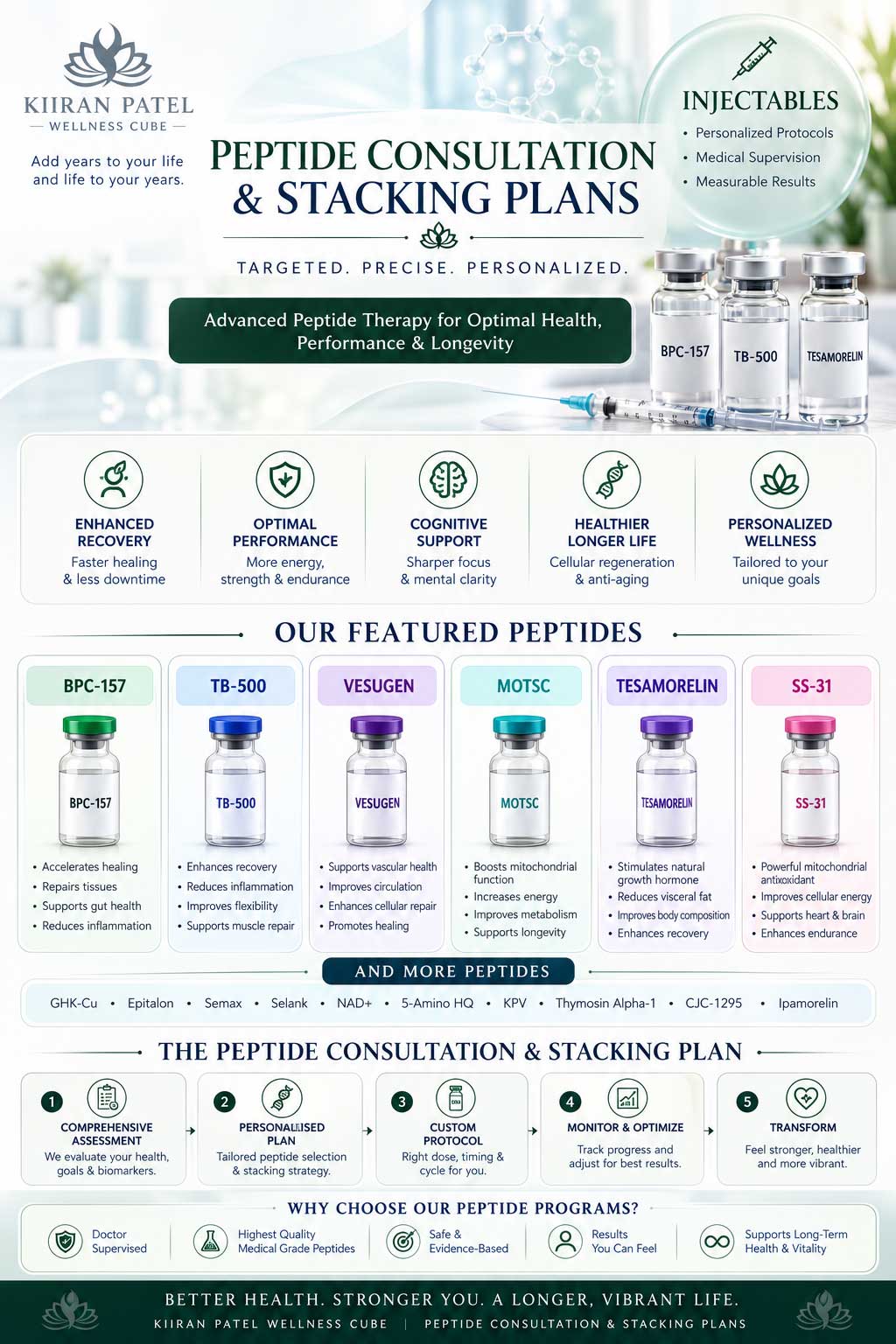
BPC-157 and TB-500 are being explored for their potential role in supporting tissue-repair pathways, recovery and the body’s natural healing response.
Mitochondrial and Metabolic Support
MOTS-c and SS-31 are being researched for their potential to support mitochondrial function, cellular energy, metabolic efficiency and physical resilience.
Neurological and Cognitive Support
Semax and Selank are being studied for their potential influence on focus, mental clarity, stress response and emotional balance.
Healthy Ageing and Sleep
Epitalon is an emerging peptide of interest in healthy-ageing research, particularly for its potential relationship with sleep regulation, cellular health and longevity pathways.
Immune-System Support
Thymosin alpha-1and KPV has been studied for its immunomodulatory properties ,anti inflammatory and potential ability to support a balanced, coordinated immune response.
These applications remain areas of emerging research. Suitability should be assessed individually, with appropriate medical supervision and monitoring.
Our peptide consultation pathway
1) Define the clinical objective :
We begin by understanding what you hope to improve and whether that concern has been properly evaluated. Fatigue, slow recovery, weight change, poor sleep and reduced performance can have many causes that should not automatically be attributed to a “peptide deficiency.”
2) Review medical suitability :
Assessment may include :
Complete medical and family history.
Current diagnoses, medicines and supplements.
Allergies and previous adverse reactions.
Blood pressure, weight trend and body composition.
Metabolic, liver, kidney and thyroid health.
Cancer, pancreatic, gallbladder, gastrointestinal or endocrine history. Fertility, pregnancy or breastfeeding considerations. Mental-health and eating-disorder history where relevant.
3) Review the evidence and regulatory status :
Before any treatment decision, we discuss :
Whether the proposed therapy is approved for the intended use.
The quality of available human evidence.
Known and unknown risks.
Established alternatives.
Product quality and sourcing considerations.
What monitoring would be required.
If a compound is investigational, that status should be explicitly disclosed. Experimental treatment should never be presented as guaranteed, proven or risk-free.
4) Create an integrated plan :
Where an appropriate, legally available treatment is selected, it forms only one part of the plan. Nutrition, protein intake, resistance exercise, sleep, recovery, metabolic health and any existing medical therapy remain essential.
5) Monitor response and safety :
Monitoring is determined by the medicine and the patient. It may include symptoms, adverse effects, weight and waist trend, body composition, blood pressure, glucose, HbA1c, kidney or liver markers and other treatment-specific investigations.
Lack of benefit, intolerable adverse effects or a change in risk profile should trigger reassessment or discontinuation—not automatic dose escalation.
Why body composition matters during weight-loss treatment?
Weight reduction can include loss of both fat and lean tissue. Preserving muscle is especially important for strength, metabolic health, mobility and healthy ageing.
Where a peptide-based obesity medicine is clinically appropriate, we combine it with :
Adequate dietary protein.
Progressive resistance exercise.
Appropriate energy intake.
Hydration and micronutrient support.
Monitoring of strength and body composition when available.
A long-term maintenance strategy.
The goal is not simply to make the number on the scale smaller. It is to improve health while protecting function.
The Kiiran Patel Wellness Cube approach
Individual assessment: treatment begins with the patient, not the product.
Evidence transparency: established benefits are separated from emerging hypotheses.
Whole-person care: nutrition, hormones, sleep, movement and metabolic health are addressed together.
Ongoing monitoring: response and risk are reviewed throughout treatment.
Informed decisions: limitations, alternatives and unknowns are discussed clearly.
Add years to your life and life to your years..
Curious about peptide-based therapies?
Book a consultation with Kiiran Patel Wellness Cube for an individual evaluation of your health goals, current treatments and the evidence behind available options.